The first look does something to people. You walk past the row of warungs at the clifftop, the ground falls away in front of you, and there it is: a limestone headland shaped like a sleeping dinosaur, a ribbon of white sand at its jaw, and water in three separate shades of blue. Nusa Penida Kelingking Beach is the image that sells Indonesia to the world, and it is one of the rare places that looks better in front of you than it does on a screen.
It is also the place travellers misjudge most often. Most arrive at midday with the day-tour boats, queue for a photograph in hard light, look at the path down, then either leave slightly deflated or start a descent they are not dressed for.
The pressure is easy to explain. BPS Statistics Bali recorded 6,948,754 direct foreign arrivals to Bali in 2025, an increase of 9.72 percent on the previous year, and a large share of those visitors put this single viewpoint on a day-trip list.
This guide gives you the boat timings, the trail detail, the honest safety picture and the current status of the cliff lift, so you turn up knowing exactly what you are walking into and how to plan the rest of the day around it.
Why Nusa Penida Kelingking Beach Is Worth the Journey
The name comes from the Indonesian word for little finger, which is what the local community saw in the shape of the headland long before anyone called it T-Rex Bay on Google Maps. The site sits on the south-west coast of Nusa Penida, in Klungkung Regency, with Bunga Mekar the nearest village. Kelingking Beach Indonesia is not a resort beach and never has been. There are no loungers, no beach club, no vendors on the sand, and nothing at the bottom except limestone walls, a sea cave and a shore break that sounds enormous once the cliffs amplify it.
That is the appeal. Everywhere else you will photograph in Bali has been tidied for visitors. This one has not. It suits couples who want a genuine landscape moment, photographers, and anyone travelling with older children who are steady on their feet. It suits families with toddlers too, as long as you treat the viewpoint as the destination and skip the descent entirely. Nobody should feel short-changed by staying at the top. The view of Kelingking Beach Bali from the clifftop is the shot, and the sand below is a bonus rather than the point.
How to Get to Kelingking Beach
Almost everyone starts from Sanur, where the fast boats to the Nusa Islands leave from the beach terminal. The crossing takes roughly 45 minutes to Toyapakeh or Banjar Nyuh harbour. Boats also run from Padang Bai on the east coast, which suits you if you are already staying in Candidasa or Amed. Book the earliest sailing you can, usually between 7am and 8am, because the difference between arriving at 9am and arriving at 11am is the difference between an empty viewpoint and a crowded one.
From either harbour, the drive across to the west coast takes 45 to 60 minutes. Nusa Penida roads have improved but they are still narrow, steep in sections and busy with scooters, so ride-hailing apps are unreliable once you leave the port area. Most visitors either rent a scooter for the day or arrange a car with a local driver. If you are not an experienced rider on hills and rough surfaces, take the driver. It is the same decision you face on the mainland, and our guide to getting around Bali applies here with the difficulty turned up. A private car and driver also means you can leave your bag in the vehicle while you hike.
Parking sits directly above the viewpoint, with warungs and toilets beside it. Bring small notes. Parking charges and any local entry contribution are cash only, and there is no ATM within a useful distance.
Best Time to Visit
The dry season runs from April to October, and it matters more here than at most Bali sights because the trail turns slick in rain and the sea below loses its colour under clouds.
| Period | Conditions | What it means for your visit |
| April to June | Dry, warm, moderate crowds | The sweet spot. Clear water, manageable trail, boats running reliably. |
| July and August | Driest months, peak season | Best weather, worst crowds. Be at the viewpoint before 9am or skip it. |
| September and October | Dry, quieter, excellent light | Shoulder season at its best. Boats are still dependable, prices softer. |
| November to March | Wet season, humid, rougher seas | Afternoon downpours, slippery steps, more boat cancellations. Go early in the day. |
| Nyepi (March) | Bali’s day of silence | The whole province closes, including boats and the airport. Plan around it. |
For light, aim for the first two hours after sunrise or the last hour before sunset. Late afternoon puts the sun behind the headland and gives you a silhouette rather than the blue water most people are hoping for. If you are still fixing your travel dates, the best time to visit Bali is worth reading before you commit.
The Hike Down: What It Actually Involves
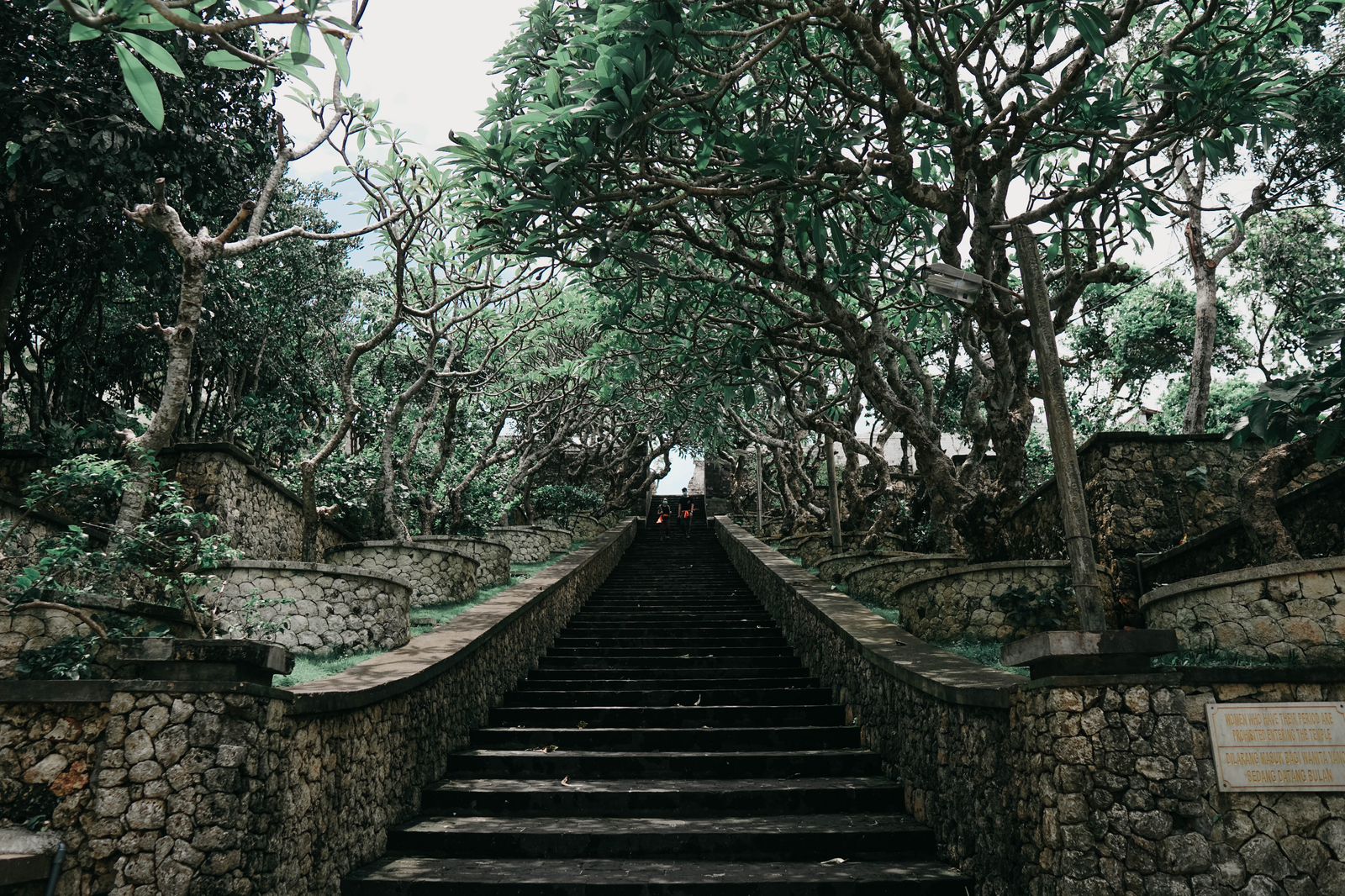
Calling it a staircase oversells it. Much of the route now has concrete steps, timber handrails and fixed ropes, which is a significant improvement on the bamboo and packed mud of a few years ago, but sections still drop at 70 to 80 degrees, the treads are uneven, and there is exposed ground on one side. The Kelingking Beach stairs are best described as a scramble with assistance rather than a walk.
Allow 30 to 45 minutes going down and 45 to 90 minutes coming back up, plus time on the sand. The climb out is the hard half, and the heat matters more than the gradient. The Kelingking Beach hike is realistic for anyone with moderate fitness and closed-toe shoes with grip. It is not realistic in flip flops, and it is not suitable for children under about ten, for anyone with knee or hip problems, or for anyone who is already tired at the top.
Three things to carry: two to three litres of water per person bought at the top, because nothing is sold below, sun protection for a trail with almost no shade, and a phone you do not need to rely on, since signal at the bottom is patchy at best. Check the Bali packing list before you leave your hotel if you are travelling light.
On the beach itself, the large sea cave at the northern end gives you shade and a striking frame back out to the water. Most visitors photograph the sand and miss it entirely
Is Kelingking Beach Dangerous?
The viewpoint is not. It is open ground with fencing in the busiest sections, and it is fine for all ages provided you stay behind the barriers and resist the urge to sit on an unprotected edge for a photograph.
The water is a different matter. Swimming has been officially prohibited since February 2023, after a tourist drowned trying to help another swimmer caught in the shore break. Waves arrive with very little warning, there is no lifeguard service on the sand, and a rescue means carrying someone back up the same trail you came down, which takes well over an hour. Warnings from local officials are repeated every season for a reason, and people still wade in. Admire the water from the sand and keep out of it.
The more common problem is heat. Dehydration and exhaustion on the climb out affect far more visitors than anything in the sea. Start early, rest in shade before you begin the ascent, and turn back at any point without embarrassment. Comprehensive travel insurance that covers hiking is sensible for this island generally.
The Cliff Lift: Where the Project Stands in 2026
You will still find articles promising an easy ride to the sand. Here is the current position. A 182-metre glass structure designed to carry visitors down the cliff face began construction in 2023, backed by a foreign investment group, and work was halted in October 2025 after sustained objections over permits, zoning and the damage to the cliff itself. In November 2025 Bali’s governor ordered the structure demolished within six months, citing planning violations.
The dispute has continued through the courts, with the investor winning an administrative case in September 2026 and the province appealing. Nothing is operating, and no work has restarted. In practical terms, the Kelingking Beach elevator is not an option for your trip, and you should plan on foot or plan to stay at the top. If access ever changes, it will be widely reported well before it opens.
What to Combine With It in One Day
Kelingking sits on the standard west coast loop, and going clockwise from the harbour keeps you ahead of the tour convoys. Broken Beach and Angel’s Billabong are ten minutes further along the same road and take about an hour together. Crystal Bay is the swimming and snorkelling stop the day needs, and it is where most sunset watchers end up.
Two quieter alternatives are worth your time. Banah Cliff viewpoint, a short drive south, gives you a rock arch and sea views with a fraction of the people. Tembeling Forest and its natural spring pools involve a steep track down through shaded jungle and reward anyone willing to make the effort. Divers and snorkellers should build the day around Manta Point instead, where cleaning stations bring reef mantas close to the surface for much of the year.
If you can spare a night, stay on the island rather than racing the last boat. The whole of the Nusa Islands changes character after 4pm when the day boats leave. A Nusa Penida itinerary spread over two days turns a rushed checklist into an actual trip.
Costs and Practicalities
Figures below are 2026 estimates for planning purposes and move with season and demand.
| Item | Typical cost | Notes |
| Fast boat return, Sanur to Nusa Penida | USD 25 to 45 per person | Book a morning departure and a late afternoon return. |
| Scooter rental, full day | IDR 80,000 to 100,000 | Only for confident riders. Helmets and a valid licence required. |
| Car with local driver, half day | IDR 350,000 to 500,000 | Splits well between four people and removes the hardest variable. |
| Parking and local entry contribution | Small cash amounts | Cash only. Pay at the official booth, not to anyone on the approach road. |
| Guesthouse, per night | IDR 300,000 to 700,000 | Simple, clean, often with a pool. Book ahead in July and August. |
| Clifftop resort, per night | USD 150 and up | Limited stock on the island. Worth reserving months out. |
Food at the top is warung fare done well: nasi goreng, mie goreng, nasi campur and cold drinks with a view most restaurants would charge a premium for. Eat before you hike rather than after. Vegetarian options are straightforward, and halal food is widely available across the island.
Etiquette and Travelling Responsibly Here
- Dress modestly at the viewpoint and carry a sarong if you are also visiting Giri Putri cave temple on the same trip.
- Carry your rubbish back up. There is no collection on the beach and litter ends up in the sea.
- Fresh water is genuinely scarce on Nusa Penida. Short showers and a refillable bottle matter more here than in Seminyak.
- Choose small-group manta operators that keep their distance and never touch or chase the animals.
- Spend at the warungs at the top. That money stays in Bunga Mekar rather than leaving with the boat.
Mistakes Travellers Make at Kelingking
- Arriving between 11am and 2pm, when the light is flat and the viewpoint is at its busiest.
- Attempting the descent in sandals. Footwear causes more incidents here than the gradient does.
- Carrying one small bottle of water for a climb that takes up to 90 minutes in full sun.
- Booking the last boat back and then rushing the ascent to catch it.
- Entering the water despite the ban, usually after watching someone else do it first.
- Arriving with no cash, then finding parking, food and entry are all cash only.
- Treating the island as a half-day add-on to a Bali beach day, which leaves no margin for delays.
- Trying to cover the west and east coasts in a single day trip and seeing both badly.
- Standing on unfenced edges for photographs on loose, crumbling limestone.
- Assuming the cliff lift is running and arriving without the shoes or the water to walk down.
Local Tips Most Guides Leave Out
- Walk five minutes south past the main platform. The secondary viewpoints have the same angle and almost nobody on them.
- Manta rays are often visible from the clifftop in the morning, as dark shapes move slowly across the pale shallows. Bring binoculars if you have them.
- Start the climb back up before 2pm. After that the rock face holds heat and the ascent gets noticeably harder.
- Download offline maps before you leave the harbour. Coverage across the interior of the island is unreliable.
- If the sea is rough and the beach looks unwelcoming, switch your day to Crystal Bay and come back to the viewpoint at sunrise the next morning.
- Photographers should shoot from the right-hand side of the platform in the morning, which keeps the sun behind you and the water lit.
Planning Your Visit
Kelingking Beach rewards preparation more than most sights in Indonesia. Get there early, wear proper shoes, carry more water than feels necessary, decide honestly whether the descent is for you, and stay out of the water. Do those five things and you will come away with the view that made the place famous and none of the stories that make travellers regret the trip.
The harder part is fitting it into a trip that flows: which harbour, which morning, what you see on either side of it, and whether an overnight on the island makes more sense than a long day trip. That is where a locally planned itinerary earns its keep. Take a look at our Bali vacation packages for an idea of how the days fit together, or get in touch with your dates and we will build a plan around Nusa Penida Kelingking Beach that suits how you actually like to travel.
Frequently Asked Questions
- Can you still walk down to the beach?
Yes. The trail is open and remains the only way down. Allow 30 to 45 minutes descending and up to 90 minutes climbing back. - Is there an entrance fee?
Charges are modest and local, covering parking and a small community contribution. Bring small notes and pay at the official booth only. - Can you swim at the bottom?
No. Swimming has been prohibited since February 2023 because of a severe shore break and no lifeguard cover. - Is Kelingking Beach Nusa Penida suitable for children?
The viewpoint suits any age. The descent is not appropriate for children under about ten. - How long should I allow for the whole site?
Thirty to forty minutes for the viewpoint alone. Three hours if you hike down and back with a rest on the sand. - Do I need a guide for the hike?
No. The route is obvious and busy. A guide adds nothing beyond company. - Can I visit as a day trip from Bali?
Yes, and most people do. A first boat out and a late afternoon return gives you a comfortable west coast loop. - What should I wear?
Closed-toe shoes with grip, breathable clothing, a hat and sunscreen. Change for swimming at Crystal Bay instead. - Are there toilets and food at the top?
Yes, beside the car park, along with several warnings. There is nothing at all on the beach. - Do I need a visa to visit?
Most nationalities can buy a visa on arrival. Check the current Bali visa requirements before you travel, along with the arrival declaration and tourism levy. - Is the island worth more than one day?
Yes. Two nights lets you see both coasts properly and puts you at the viewpoint before the day boats arrive.