Here is the thing nobody mentions when they post the photographs. Diamond Beach Nusa Penida sits on the eastern tip of the island, facing the sunrise. Broken Beach and Crystal Bay are on the west coast, roughly ninety minutes of slow, winding road away. Day tours sell all three together, and it can be done, but only if you know how the island actually drives, and you are out of the harbour early.
The water below those cliffs is not just scenery either. As recorded by the Coral Triangle Center, the Nusa Penida Marine Protected Area covers 20,057 hectares and supports 296 coral species and 576 fish species, with more than 600 individual reef manta rays identified in those waters since 2004. You are visiting one of the richest stretches of reef in the Coral Triangle, not simply a set of viewpoints.
This guide covers all three sites honestly. What each one is actually like when you arrive, how long you need, where the fees and the hazards are, and how to sequence a route so the light is on your side instead of against you.
Why the Three Sites Never Fit Neatly Into One Morning
Nusa Penida is about twenty kilometres across, which sounds like nothing. The roads tell a different story. They climb, narrow, and in places crumble at the edges, so a twenty-kilometre transfer can take an hour. The official tourism board at Indonesia Travel describes the island as rugged highland scenery ringed by beaches, and that ruggedness is exactly what slows the driving.
Plan by coast rather than by map pin. The east coast holds one cluster. The west coast holds the other. Trying to bounce between them twice in a day is how people end up seeing three car parks and very little else.
| Site | Coast | Drive from main port | Best light | Time needed |
| Diamond Beach and Atuh | East | 60 to 75 minutes | Sunrise to 9am | 2 to 3 hours |
| Broken Beach and Angel’s Billabong | West | About 60 minutes | Before 9am | 1 to 1.5 hours |
| Crystal Bay | West | 45 to 50 minutes | After 4pm | 2 hours or more |
| Kelingking viewpoint | South west | 45 to 60 minutes | Early morning | 1 to 2 hours |
Diamond Beach Nusa Penida: The Staircase, the Sand and the Current
A white crescent of sand sits at the base of sheer limestone, with weathered rock spires standing offshore like broken teeth. It is the image that puts Diamond Beach Bali on every travel feed, and in person it holds up. What the photographs flatten is the scale of the cliff and the effort of the descent.
Diamond Beach Nusa Penida stairs: what the descent is really like
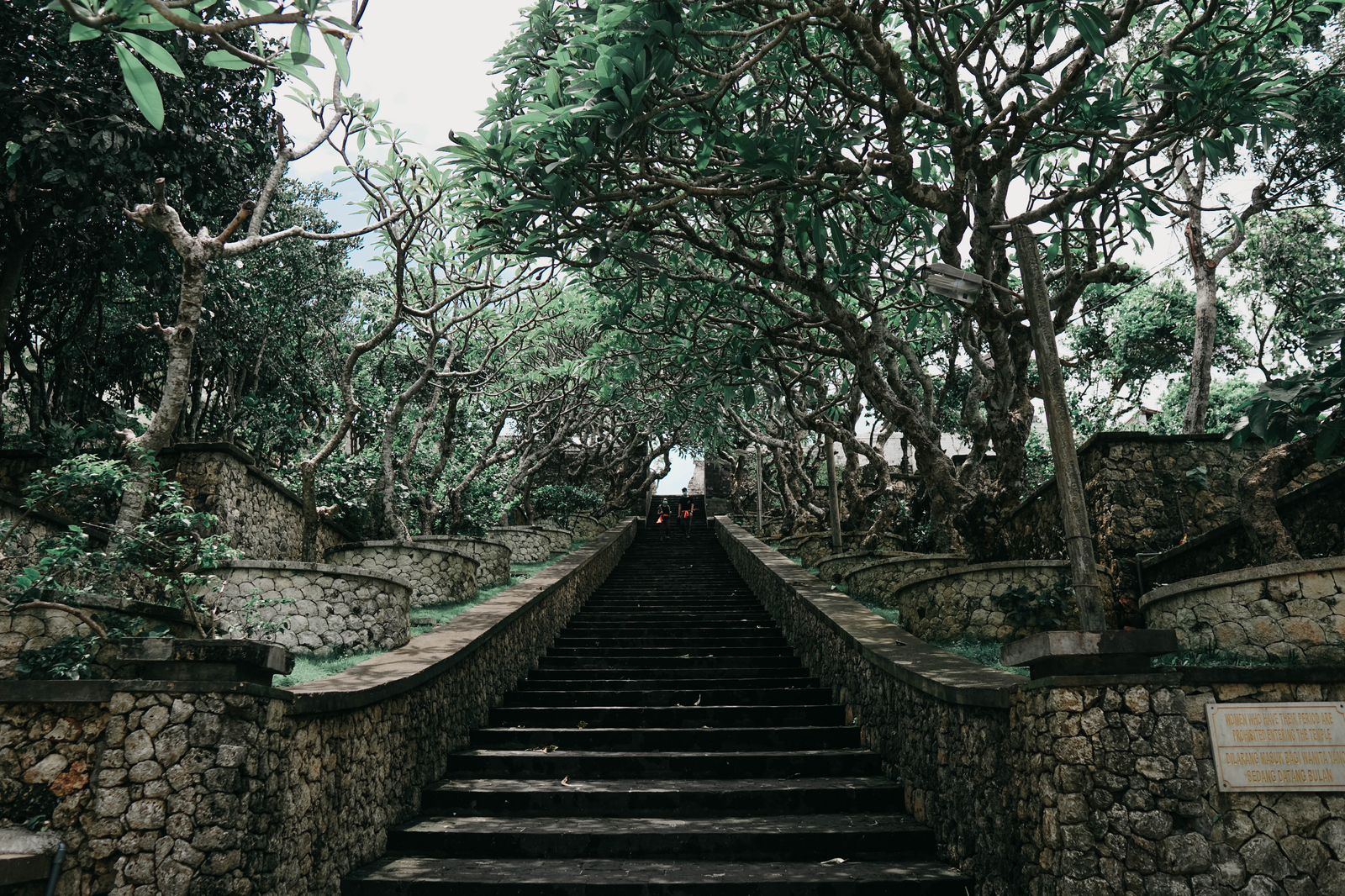
Local families carved the staircase into the cliff face around 2016. The upper section is wide, well cut and genuinely pleasant. Somewhere past the halfway point, the steps get taller and less even, and the final stretch is closer to a carved chute with a fixed rope than a staircase. Allow ten to fifteen minutes down and rather longer coming back up in the heat. Wear shoes with grip. Flip-flops are the single most common mistake here, and the climb is not sensible for small children, anyone unsteady on their feet, or anyone carrying a lot of camera gear in one hand.
Fees, timing and the light
Expect a per-person entrance fee in the region of 25,000 to 35,000 IDR plus a small parking charge, cash only, which also covers Atuh Beach and the surrounding viewpoints next door. Because the cove faces east, it is lit beautifully at dawn and sits in cliff shadow by early afternoon. Anyone planning Nusa Penida Diamond Beach photographs should be at the top of the stairs before the day boats unload around half past nine.
Swimming, and why the shore break deserves respect
The water is spectacular and the currents are serious. There are no lifeguards, the shelf drops away quickly, and the swell that makes Diamond Beach, Indonesia look so dramatic in photographs is the same swell that pulls people off their feet. Paddle at the edge, enjoy the sand, and leave the swimming for the sheltered bays. Atuh Beach, a few minutes along the same path, has a gentler entry and a row of warungs facing the water.
Broken Beach Nusa Penida and the Pool at the Cliff Edge
Known locally as Pasih Uug, Broken Beach Nusa Penida is a collapsed sea cave. The roof fell in at some point and left a circular cove connected to the ocean by a natural stone archway, with a walking loop around the rim. Sea turtles are often visible in the pool below, and manta rays sometimes cruise past the outer cliffs.
A five-minute walk from the same car park brings you to Angel’s Billabong, a natural rock channel that fills with clear water and empties with the tide. Mid to low tide is when it looks its best. Swimming there is now roped off and firmly discouraged after a series of incidents involving rogue waves sweeping across the ledge, and that restriction is worth taking seriously no matter how still the water looks at the moment.
One parking area and one small combined fee cover both sites, so budget an hour to ninety minutes for the pair. They sit twenty to thirty minutes from Kelingking Beach and around forty minutes from Crystal Bay, which is why almost every west-coast route strings the three together.
Crystal Bay Nusa Penida: Reef, Current and the Best Sunset on the Island
Crystal Bay is the softer stop of the three. A sheltered curve of sand, a rocky islet just offshore, shade under the trees and warungs selling cold drinks behind the beach. It is the one place on this route where you can sit still for an hour without feeling you are missing something.
Conditions offshore are another matter. Crystal Bay Nusa Penida snorkeling is excellent close to the beach, where the reef starts almost immediately, but the channel beyond the islet carries strong and changeable currents that catch out confident swimmers every season. Go with an operator who knows the tide, stay inside the bay, and treat local advice about where the safe water ends as instruction rather than suggestion. Between July and October the cold upwelling that feeds this coast brings mola-mola, the oceanic sunfish, close enough to be seen by divers. Manta rays are present year-round at nearby cleaning stations, and our Nusa Penida snorkelling and diving trips are timed around exactly these conditions.
The bay faces west, which makes Crystal Bay Nusa Penida sunset the natural way to close a day here. Day-trip boats leave from around four in the afternoon, the crowds thin out fast, and the light on the islet in that last hour is the reason to stay overnight rather than rush the last ferry.
Getting There and Getting Around
Fast boats cross from Sanur in around forty-five minutes and from Kusamba in about thirty, landing at Banjar Nyuh, Toyapakeh or Buyuk depending on the operator. Every arriving visitor pays a small island retribution fee at the port, now collected through a cashless system that can back up badly on busy weekends, so build in a buffer around your return crossing. Sanur is the easiest departure point if you are basing yourself in south Bali or Ubud, and it is one reason Sanur works so well for Bali island hopping.
On the island itself, the road network has improved but still includes steep gradients, loose gravel and sudden potholes. Unless you ride regularly at home, a private driver for the day is the safer and usually the cheaper choice once fuel, fees and parking are counted. Scooter accidents are the most common way visitors ruin the rest of their holiday here.
Two Routes That Actually Work
| Plan | Route | Trade-off |
| One day, west coast | Early boat, Kelingking, Broken Beach and Angel’s Billabong, lunch, Crystal Bay, late boat | Comfortable and complete, but skips the east coast entirely |
| Two days, both coasts | Day one west coast as above. Night on the island. Day two: sunrise at Diamond and Atuh, then the north coast and a midday boat | The only version that gives each site real time |
If you only have one day, choose a coast rather than chasing all four landmarks. The east coast at sunrise with no one else on the stairs is a better memory than four rushed car parks.
Mistakes to Avoid
- Booking a single-day tour that promises both coasts and then wondering why every stop feels like twenty minutes.
- Estimating travel time from distance on a map rather than from the state of the roads.
- Arriving at the eastern cliffs after eleven, when the cove is in shadow, and the climb back up is at its hottest.
- Tackling the cliff staircase in flip-flops or with a bag in each hand.
- Swimming at the cliff-edge pool or wading into the shore break below the cliffs.
- Carrying no cash, when every entrance and parking fee on the island is collected in rupiah at the gate.
- Leaving no margin for the port queue on your departure crossing.
- Hiring a scooter with little riding experience on terrain that punishes it.
- Snorkelling beyond the sheltered part of the bay without checking the current with a local operator.
- Planning a day trip in January or February, when rough seas cancel crossings at short notice.
Visiting Responsibly
Nusa Penida is also a community-protected bird sanctuary. Friends of the National Parks Foundation established the sanctuary across the three Nusa islands in 2004 to give the critically endangered Bali starling a safe habitat, working with village communities and traditional law rather than around them. Birdwatching in the island’s interior is one of the genuine pleasures here, and almost nobody does it.
- Keep well back from manta rays and never chase or touch them. The marine park operates a code of conduct for exactly this reason.
- Reef-safe sunscreen matters in a bay where the coral starts a few metres from the sand.
- Waste management on the island is stretched. Carry your rubbish back to Bali if you can.
- Eat at the warungs behind the beaches. That money stays on the island.
Planning It Properly
Take these three places at the pace they deserve and Nusa Penida becomes the best day or two of a Bali holiday. Rush them and it becomes a long car journey with good photographs. The trick is simple. One coast at a time, early starts, a driver who knows the roads, and at least one night on the island so you see Diamond Beach Nusa Penida at sunrise rather than at noon with four hundred other people.
If you would rather have the boats, the driver, the timing and the overnight stay arranged around the tides and the light, the team at Indonesian Vacations builds these routes constantly and can fold them into a wider Bali and Nusa Islands itinerary. Tell us when you are travelling and what you want to see, and we will plan the rest around it.
Frequently Asked Questions
- Can you see all three sites in one day?
Physically yes, enjoyably no. Between the crossing, the port formalities and three hours of driving, a single day leaves roughly twenty to thirty minutes at each stop. One coast per day is the version people are glad they chose. - Is swimming allowed at Angel’s Billabong Bali travellers see in photographs?
No. The pool is roped off, and swimming is discouraged because waves periodically surge across the ledge without warning. Photograph it from the surrounding rock at mid or low tide and leave it at that. - How difficult is the cliff staircase, honestly?
Moderate for the first half and demanding for the second, with a rope for the last section. Most reasonably fit adults manage it. Anyone with knee trouble, vertigo or young children should enjoy the view from the top instead, which is spectacular in its own right. - When can you see mola-mola?
July to October, when cold upwelling brings the sunfish up to cleaning stations. It is a diving encounter rather than a snorkelling one, and sightings are never guaranteed. - Which is better to visit, the eastern cove or Kelingking?
They do different jobs. Kelingking is the viewpoint, dramatic from above and brutal to descend. The eastern cove is the one where you actually reach the sand comfortably. If you only pick one beach to walk down to, pick the east. - How much cash should you bring for the day?
Enough for the port fee, two or three site entrance fees, parking at each, lunch and drinks. ATMs exist but are unreliable and often empty at weekends, so bring more rupiah than you think you need. - What is the best month to go?
May, June and September. Dry season conditions without peak-season boat queues. July and August are reliable but crowded, and the wettest months bring cancelled crossings. - Is this suitable for a family trip?
The west coast works well with children, since the viewpoints need little walking. The eastern staircase does not. Families often do the west coast as a day trip and save the rest for another visit. - Do you need a guide?
Not for the walking, but a driver who knows the roads and the tides is worth far more than the small saving of doing it alone. - How do you avoid the crowds?
Stay overnight. The island empties between about four in the afternoon and half past nine the next morning, and those hours are when these places look the way they do in the photographs. - Is one night on the island enough?
One night is the minimum that changes the trip. Two nights lets you cover both coasts at civilised hours and still have a morning spare for the north coast reefs.