
On your first morning you will nearly step on one. A palm-leaf tray on the pavement holding rice, a flower, a biscuit and a smoldering stick of incense, placed at dawn and already being picked at by a dog. By evening there will be another.
Those trays are the clearest daily evidence of Bali religion and culture, and they explain something important about the island. Religion here is not confined to buildings or weekends. It is laid on the ground outside shops, tied to car dashboards, built into the layout of houses and the timing of the working day.
The scale is easy to underestimate. According to Indonesia’s Ministry of Religious Affairs, 3.77 million people in Bali identified as Hindu in 2024, around 86.5 percent of the province, in a country that is otherwise overwhelmingly Muslim. Estimates put the number of temples and shrines on the island at roughly 20,000.
Most guides reduce this to a line about wearing a sarong. This guide covers how Balinese Hinduism works, how a temple is laid out and why that matters more than your outfit, the current provincial rules, and what happens on the one day a year the island stops.
Bali Religion and Culture: What Balinese Hinduism Is
The formal name is Agama Hindu Dharma. It shares gods and texts with Indian Hinduism but is not the same religion, and treating it as a variant misses most of what makes it distinctive.
Balinese Hinduism absorbed the animist and ancestor-worship traditions that were already here. Mountains, springs, trees and the sea hold power in their own right. Ancestors are actively present rather than remembered. Buddhist figures appear alongside Hindu ones. The result is a belief system where the spiritual and the physical are not separate categories.
The organising philosophy is Tri Hita Karana, three causes of wellbeing: harmony with the divine, harmony between people, and harmony with the natural world. It is not an abstraction. It shapes how rice terraces are irrigated through the subak system, which UNESCO inscribed as a World Heritage cultural landscape, and it is the reason a hotel will have a shrine in its car park.
Direction matters too. Kaja, towards the mountains, is auspicious. Kelod, towards the sea, is not. Villages, temples and houses are oriented on that axis.
Bali Religion Percentage: The Numbers
The Bali religion percentage breakdown surprises people who expect Indonesian demographics.
| Religion | Followers (2024) | Share |
| Hindu | 3,773,617 | 86.5 percent |
| Islam | 444,905 | 10.2 percent |
| Protestant | 75,233 | 1.7 percent |
| Catholic | 36,959 | 0.9 percent |
| Buddhist | 29,683 | 0.7 percent |
The Hindu Bali most visitors picture is the only Hindu-majority province in Indonesia, a legacy of priests and elites moving east from Java as the Majapahit empire collapsed in the sixteenth century, with the Bali Strait acting as a barrier.
How a Temple Is Laid Out, and Why It Matters
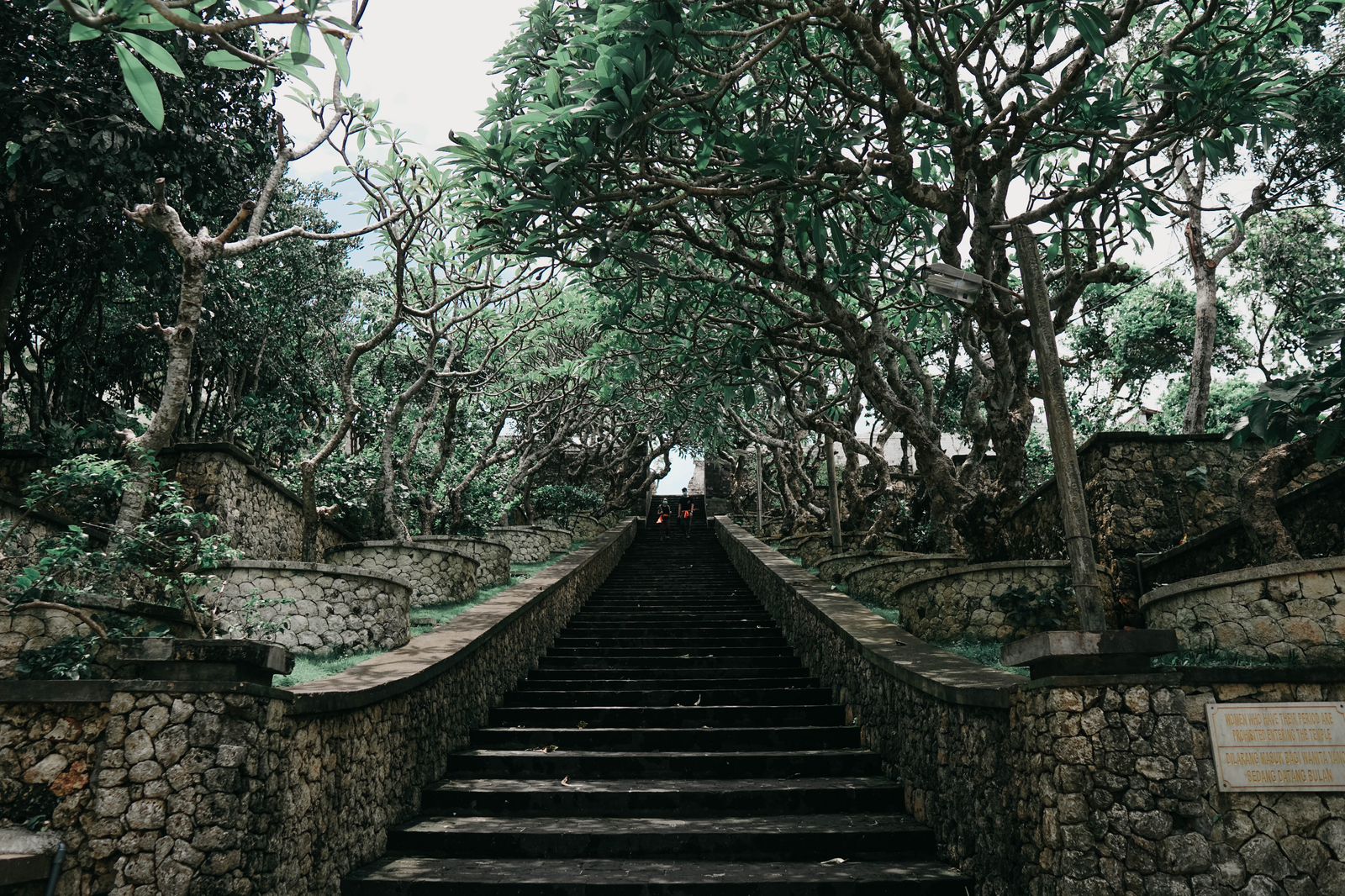
This is the part almost no travel article explains, and it answers most etiquette questions before they arise. A Balinese pura is not one building. It is a series of walled courtyards, arranged from least to most sacred as you move inward.
- Nistaning mandala, the outer courtyard. Social space, gatherings, occasionally a market
- Madyaning mandala, the middle courtyard. Ceremonial preparation, offerings, gamelan
- Utamaning mandala, the inner sanctum. The shrines themselves, and the part that matters most
Most temples open to visitors give access to the outer areas only. At the well-known sites, the split gate candi bentar you photograph usually leads into a courtyard you can enter, while the shrines beyond are closed to non-worshippers.
Every traditional village also maintains three temples: Pura Puseh for origins, Pura Desa for the village, and Pura Dalem, associated with death, near the cemetery. Somewhere quiet with no ticket booth is probably one of these, and probably not for visiting.
Bali Temple Dress Code: Sarong, Sash, Shoulders
The Bali temple dress code is straightforward once you know the three components.
A kamen, the sarong, is wrapped to cover the legs to the ankles. Men and women both wear one. Then a selendang or senteng, a sash tied at the waist over the sarong. The sash is not decorative. It marks the division between the lower body and the upper, and turning up without one is the most common mistake visitors make. Finally, shoulders covered. Vest tops and strappy dresses do not pass, whatever the sarong situation.
On what to wear in Bali temples practically: most ticketed temples lend a sarong and sash with entry, sometimes included and sometimes for a small deposit. The loaners are often thin and awkwardly sized. Buying your own for around Rp 100,000 at any market is worth it if you plan to visit more than two temples, and it doubles as a beach wrap and a shoulder cover on cold flights.
Two things that surprise people. Hats come off. And if you have an open wound that is bleeding, you should not enter, which is the same principle behind the rule below.
The 2025 Provincial Rules for Visitors
In March 2025, Governor Wayan Koster issued Circular Letter Number 7 of 2025, setting out conduct expected of foreign tourists. It is worth knowing what it actually says, because coverage of it was patchy.
As published by the Love Bali provincial portal, visitors may not enter the Utamaning Mandala and Madyaning Mandala of temples unless they are worshippers in traditional Balinese attire. Climbing sacred trees or monuments is prohibited, as are inappropriate or nude photographs at religious sites. The circular also covers littering, single-use plastics, disrespectful behaviour and working without permits.
The same circular states that menstruating women are prohibited from entering those inner areas. This is a long-standing custom in Balinese Hinduism rather than a new invention, and it is signposted at temple entrances across the island. It has attracted international debate, and Balinese commentators are not unanimous about it either. In practice it is not checked at the gate, it applies to the inner courtyards rather than the outer areas most visitors see, and it is left to individual conscience. Knowing it exists means you can make your own decision rather than being surprised by a sign.
Bali Temple Etiquette: The Rules That Matter
- Do not step on offerings. Walk around them. If you scuff one, nobody minds, since it has already served its purpose
- Never walk in front of someone praying. Go behind them
- Do not stand higher than a priest, which mostly means not climbing walls or platforms for photographs
- Do not point your feet at a shrine when sitting
- Point with your thumb or an open hand, not an index finger
- Do not touch anyone’s head, adults or children
- Use your right hand to give and receive
- Enter quietly during ceremonies, stay at the back, use no flash
- Do not photograph people praying without asking, and never from in front
- If a ceremony is in progress and there is no obvious visitor area, the answer is to leave
One more that is easy to miss: a family in mourning is ritually restricted from entering temples for a period. If your driver declines to come inside with you, that is often why.
Nyepi Day: When the Island Stops
Nyepi day Bali is unlike any public holiday anywhere else, and it needs planning around rather than avoiding. It is the clearest annual expression of Bali religion anywhere in the calendar, and it is the Balinese New Year in the Saka calendar. For twenty-four hours, from six in the morning until six the next morning, the entire island stops. No flights in or out. No vehicles on the roads. Shops closed, lights dimmed, nobody outside, including visitors. Traditional pecalang wardens enforce it. Ngurah Rai is the only airport in the world that closes annually for a religious observance.
The next one falls on 8 March 2027. Confirm the date before booking flights, because it moves each year with the lunar calendar.
The night before is the opposite of silence. Villages parade ogoh-ogoh, enormous papier-mâché demon effigies, through the streets with gamelan and torches, then burn them. It is one of the great spectacles in Southeast Asia and open to anyone.
Being in Bali for Nyepi is not a wasted day if you plan for it. Hotels feed guests and keep pools open quietly. Bring a book, buy cash and snacks beforehand since ATMs and shops shut, and note that the sky that night is the darkest you will see it.
The Ceremonies You Will Actually Encounter
Bali religion and culture run on two calendars at once. The lunar Saka calendar sets Nyepi. The 210-day Pawukon cycle sets almost everything else, which is why dates move and why some festivals happen twice in one Gregorian year.
Galungan and Kuningan mark the triumph of dharma over adharma. Every household erects a penjor, a tall curved bamboo pole, and the villages look extraordinary. In 2027 Galungan falls on 13 January and again on 11 August, with Kuningan ten days after each.
Odalan is a temple’s anniversary, every 210 days. With around 20,000 temples, one is happening somewhere every day. Your driver will know. Melukat, ritual purification at a water temple such as Tirta Empul near Ubud, is increasingly offered to visitors. It is a genuine religious rite, not a spa treatment. Go with a guide who can explain the sequence, wear the right clothing, and follow the queue rather than jumping it for a photograph.
Seeing It Properly
The Bali religion and culture you will remember is rarely the famous temple at sunset with four hundred other people. It is a village odalan you were invited into, a funeral procession that closes the road for twenty minutes, or a priest explaining what the offering on your dashboard is for.
Those things need someone who knows what is happening this week and where. Tell us how long you have and what you want from the trip, and we will build the days around it. Message us on WhatsApp or through our contact page.
Frequently Asked Questions
- What is the main Bali religion?
Balinese Hinduism, or Agama Hindu Dharma, followed by about 86.5 percent of the population. Bali is the only Hindu-majority province in Indonesia. - Do I need to wear a sarong at every temple?
Yes, at any temple you enter, along with a sash and covered shoulders. Most ticketed temples lend both at the entrance. - Can I buy a sarong beforehand?
Yes, and it is worth it. Around Rp 100,000 at any market, and better quality than the loaners. - Are non-Hindus allowed inside temples?
Into the outer courtyards at temples open to visitors, yes. The inner sanctum is restricted to worshippers in traditional attire. - What is the rule about menstruation?
Women who are menstruating are asked not to enter the inner temple areas. It is a long-standing custom, restated in the 2025 provincial circular, and left to individual conscience rather than checked. - What happens if I step on an offering?
Nothing. Try to avoid it, but the offering has already done its work once placed. Nobody will be upset. - Can I take photographs in temples?
Generally yes in visitor areas. No flash during ceremonies, never photograph people praying from in front, and never climb a shrine for a better angle. - What is Nyepi and can I still travel?
A 24-hour island-wide silence marking the Balinese New Year, next on 8 March 2027. The airport closes, so you cannot arrive or leave that day. - Is it rude to watch a ceremony?
No, if you are dressed properly, stay at the back and stay quiet. Balinese ceremonies are public. Being obtrusive is the problem, not being present. - Should I make a donation at a temple?
Entry fees cover upkeep. A small donation at a village temple is welcome but never expected, and there is no set amount.