There’s no single typical day for a Balinese person, any more than there’s one typical day for anyone anywhere. A hospitality worker in Seminyak, a rice farmer in Tabanan, and a university student in Denpasar live genuinely different daily lives, shaped by where they live, what they do, their generation and their religious practice. What follows aims to show that range honestly, rather than flattening it into a single postcard routine.
Religion and Daily Offerings
Most Balinese people practice Balinese Hinduism, a tradition with its own distinct historical development rather than a direct import of Hinduism from India, though Bali is also home to Muslim, Christian, Buddhist and other communities, particularly in urban centers like Denpasar. For many Hindu households, religious practice is woven into daily life rather than confined to a weekly service.
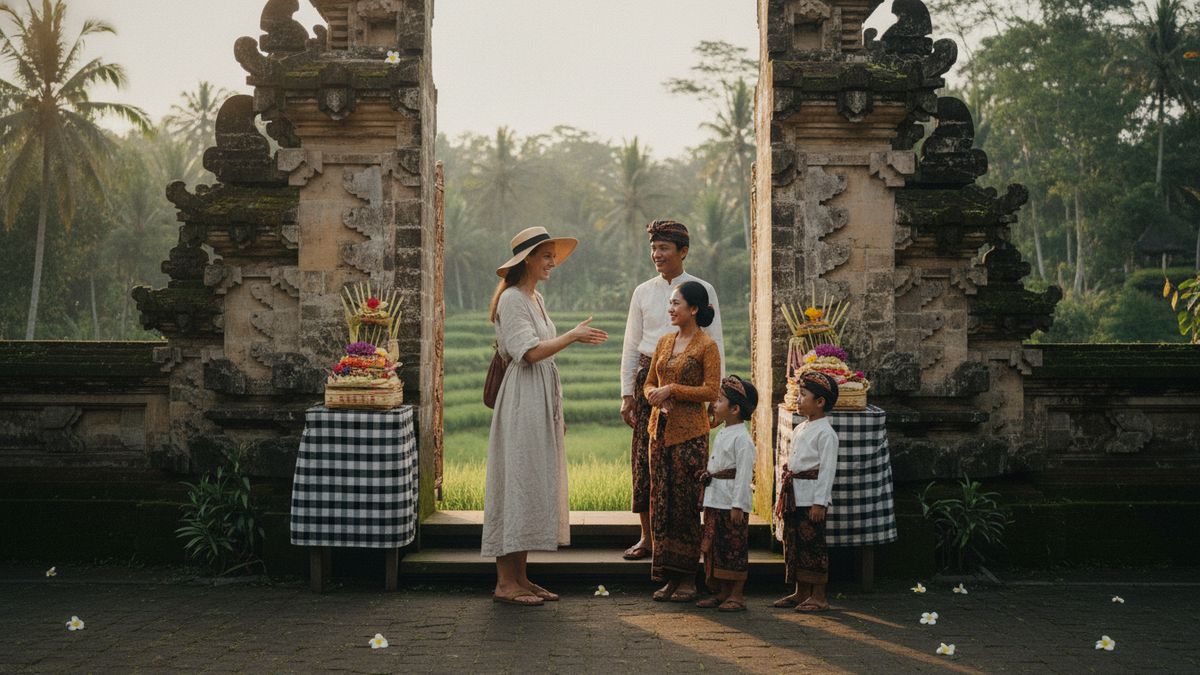
The small offering trays you’ll see constantly on streets, in shop doorways and outside homes, canang sari, are a genuine part of that practice: woven palm-leaf trays holding flowers, rice and incense, placed as a daily expression of gratitude and spiritual balance. They’re renewed daily by many households and businesses. Visitors should step around them rather than over or on them; they aren’t decorative litter, they’re an active religious practice happening in public space.
Family and Community Life
Extended family living arrangements, often within a family compound that includes a household temple, remain common in many Balinese communities, though this varies by area and generation, and plenty of families, especially in urban areas, live more independently. Community life is often organized through the banjar, a local neighborhood or village association that coordinates ceremonies, mutual assistance and local decision-making. Gotong royong, a broader Indonesian concept of community cooperation, shows up in Bali through shared responsibility for ceremonies, maintenance and community events.
What a Day in Bali Can Look Like
These are illustrative examples of different lifestyles, not universal routines or real individuals.
- A tourism worker in a coastal area might start early with a commute to a hotel or restaurant, work a shift built around guest needs and peak dining or activity times, and return home in the evening for family time or a community obligation, sometimes juggling shift patterns very different from a 9-to-5.
- A rice farmer in a rural regency often works around the demands of the crop and the Subak irrigation schedule shared with neighboring farmers, with mornings and early evenings in the fields and the workday shaped by weather and water timing rather than a fixed clock.
- A small business owner in a town center might open a shop or warung early, handle the practical realities of stock, customers and family responsibilities through the day, and close in the evening, with less separation between work life and home life than a salaried job.
- A student in Denpasar attends school or university, spends time with friends and family, and increasingly navigates the same digital and social media landscape as students anywhere, alongside participation in family and community religious obligations.
Work and Occupations
Tourism and hospitality are genuinely significant to Bali’s economy, but they don’t represent most of it. As of August 2025, official labour statistics show a workforce of roughly 2.70 million employed people, with wholesale and retail trade the fastest-growing sector and continued growth in accommodation and food service, while agriculture, forestry and fisheries employment has been declining as a share of the total, even though farming remains culturally and economically important in many areas. Construction, transportation, education, government and a growing range of small and creative businesses round out an economy that is considerably more varied than a beach-resort image suggests.
Rural Life vs. Tourist Areas
| Aspect | Rural or traditional community | Major tourist area |
|---|---|---|
| Work | Farming, local trade, community roles | Hospitality, retail, services tied to visitor demand |
| Daily rhythm | Shaped by agricultural and religious calendars | Shaped more by shift patterns and visitor seasons |
| Tourism influence | Limited direct exposure in many villages | Central to daily economic life |
| Transport | Motorbikes, some local buses, less traffic | Heavier traffic, ride-hailing widely used |
| Community life | Banjar structures often central to daily coordination | Still present, though sometimes less visible amid tourism infrastructure |
Ceremonies and Nyepi
Religious ceremonies, from smaller temple observances to larger island-wide occasions like Galungan, Kuningan and Odalan (a temple’s anniversary), are a real and regular part of community life for many Hindu Balinese families, though frequency and scale vary by location and family. These aren’t staged for tourists; if you encounter one, ask before photographing and keep a respectful distance rather than treating it as entertainment.
Nyepi, the Balinese Day of Silence marking the Saka lunar New Year, is the most significant island-wide observance. For 24 hours, the entire island stops: no flights, no vehicles, no visible lights, and everyone, residents and visitors alike, stays inside. The next occurrence falls on Monday, March 8, 2027. It reflects genuine religious significance rather than simply being an inconvenience to plan travel around.
Food and Mealtimes
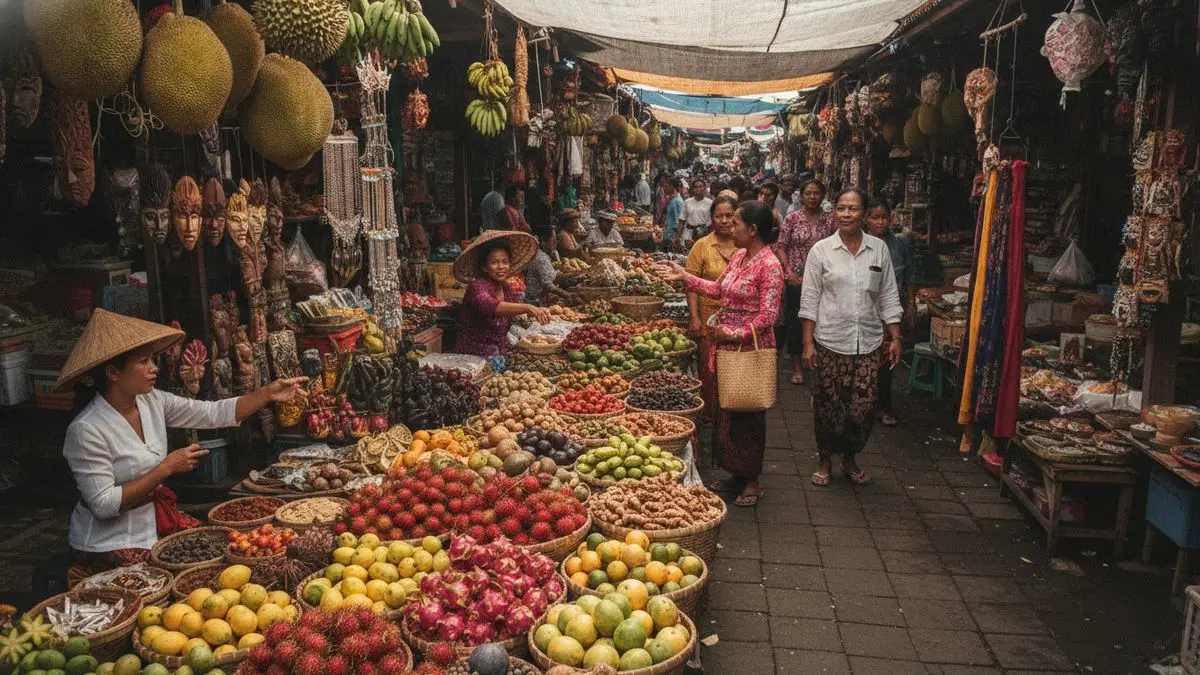
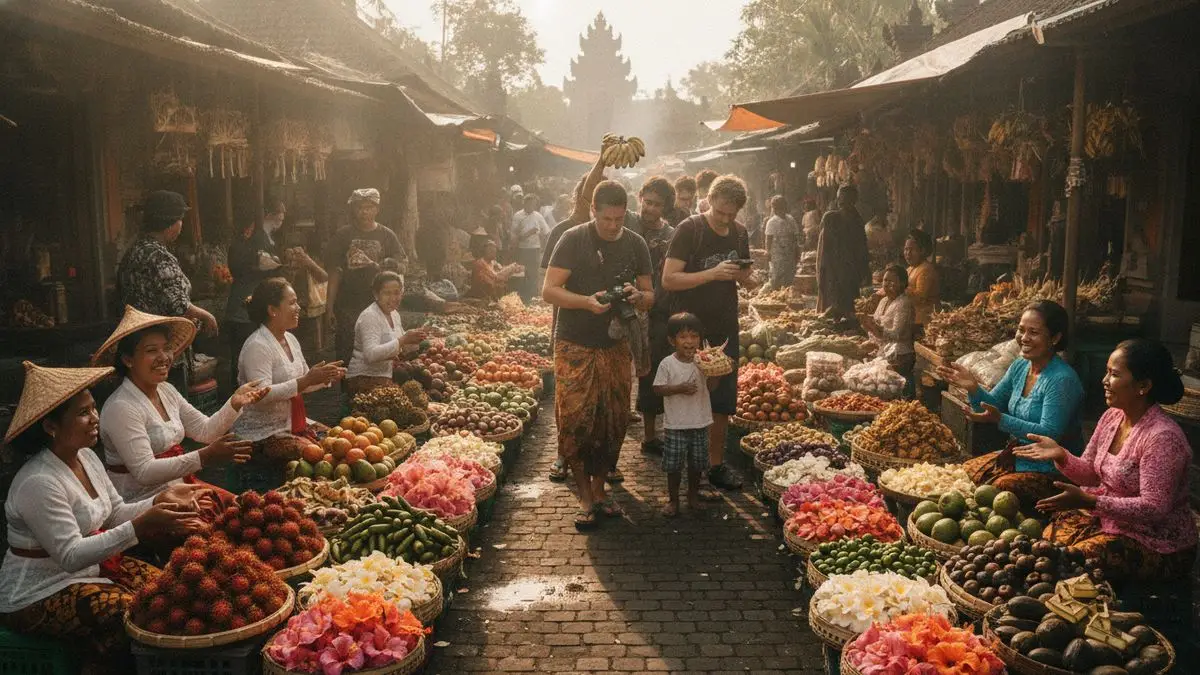
Rice is the staple across most Balinese households, and home cooking, warungs and street food all play a real role in everyday eating, not just in the tourist-facing food scene. Dishes like nasi campur, lawar, sate lilit and ayam betutu are genuinely part of Balinese food culture, though not every dish is eaten by every person; lawar’s traditional pork or blood-based versions, for instance, aren’t part of Muslim households’ cooking. For a fuller look at Balinese versus broader Indonesian food, see the Indonesian Vacations food guide.
Modern Balinese Life
Traditional culture and contemporary life coexist rather than sitting in opposition. Smartphones, social media, university education and modern careers are all part of daily life for many Balinese people, including in families that also maintain family temples and participate actively in religious ceremonies. Younger Balinese, particularly in urban centers, increasingly work in fields like design, technology and creative industries alongside more traditional occupations, and modern housing exists alongside traditional family compounds across the island, not as a replacement for tradition but alongside it.
What Tourists Often Misunderstand
- Bali is a province of Indonesia, not a separate country
- Not everyone in Bali works in tourism; the economy is genuinely diversified
- Not every Balinese person follows identical religious practices, and Bali includes non-Hindu communities too
- Traditional dress is worn for temple visits and ceremonies, not as everyday clothing for most people
- Village life differs significantly across the island; there’s no single “traditional village” experience
- Religious ceremonies are lived practice, not performances staged for visitors
- English proficiency varies significantly by area and isn’t universal
Cultural Etiquette for Visitors
- Dress modestly at temples: covered shoulders and knees, a sarong where required
- Step around offerings on the ground, never on or over them
- Ask before photographing people, and be especially careful around ceremonies
- Keep noise low and behavior respectful at religious sites
- Follow posted rules and local instructions at temples and during ceremonies
Frequently Asked Questions
- What is daily life like in Bali?
It varies significantly by location, occupation and generation, from tourism and hospitality work to farming, small business and modern professional careers, with religious practice woven into daily life for many Hindu Balinese families. - What do Balinese people do for work?
A genuinely diverse mix: tourism and hospitality, retail and trade, agriculture, construction, education, government and a growing range of small and creative businesses. Tourism is significant but not the majority of the economy. - Why do Balinese people make daily offerings?
Canang sari, small woven trays of flowers, rice and incense, are placed daily as an expression of gratitude and spiritual balance within Balinese Hindu practice. - Do Balinese families live together?
Extended family compounds remain common in many communities, though this varies significantly, and many families, especially in urban areas, live more independently. - Is Bali traditional or modern?
Both, genuinely coexisting. Many Balinese people maintain religious traditions and family temples while also working modern jobs, using smartphones and social media, and pursuing university education. - What is Nyepi?
The Balinese Day of Silence, marking the Hindu New Year on the Saka calendar. The entire island stops for 24 hours, including the airport.